
You want a piece of the US economy through the S&P 500, but the basket is full of conventional banks and interest-bearing debt.
You want to ride the wave of the US economy through the S&P 500 (the index of the 500 largest US companies), but once you open the basket, there's conventional banks, interest-bearing insurance, and companies loaded with interest-bearing debt sitting inside it. Riba sneaks into a basket that's otherwise good.
Most people end up with only two choices: close their eyes and buy in anyway, or walk away entirely. But there's a third option — still buy the "haystack" (the S&P 500), just burn the riba out of it first before you hold it. That's what SPUS does.
Put all your capital into one farmer, and if his field gets hit by pests, your capital is wiped out entirely. Spread it across hundreds of farmers, and one or two bad harvests won't ruin you — the farmers who did well cover for the ones who didn't.
That's the core idea behind index investing: buy one "basket" (an index fund/ETF — an investment product holding hundreds of stocks at once, bought as easily as a single share) containing hundreds of companies at once, instead of researching and picking stocks yourself.
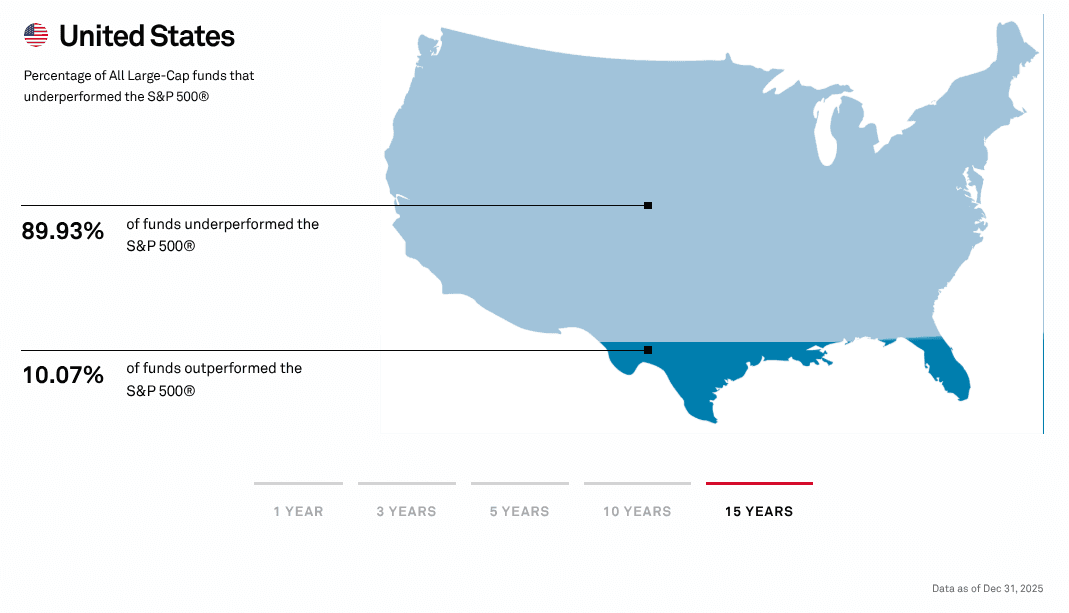
The data backs this up clearly, and it's not just an American phenomenon: SPIVA data (S&P Indices Versus Active) as of end-2025 shows the exact same pattern across 10 different markets worldwide (see the visualization below) — the overwhelming majority of active managers, even the ones with the deepest pockets and research teams, still lose to their own index. This is also why those "I made huge gains day-trading" stories you see on social media deserve some skepticism: over a month or a year, it's easy to look like a genius just because you happened to hold what was rallying. But once you stretch the window to 10-15 years like this SPIVA data does, most of those "geniuses" struggle too — it's hard to tell real skill from luck when the sample size is short.
John Bogle, Vanguard's founder, summed it up in one famous line:
"Don't look for the needle in the haystack. Just buy the haystack!"
Instead of exhausting yourself hunting for one needle (a winning stock) in a haystack, just buy the entire haystack — the needle comes along automatically. The "haystack" in this article's title means exactly that: the S&P 500/SPUS itself, the whole stack you're buying in one go. The difference is, before you buy it, the riba gets burned out first — that's covered in the next section.
This is also where keep it simple and always pick the winner become the same move: instead of gambling on one or two stocks, you buy the whole index — automatically holding whichever winner shows up, without ever having to guess who it'll be.
Note: this doesn't mean stock picking always loses — Warren Buffett is a clear example of someone who beat the index for decades. But that's a rare exception requiring skill and discipline most investors don't have; for the average investor, the index remains the more realistic bet.
SPUS (SP Funds S&P 500 Sharia Industry Exclusions ETF), in short, is the S&P 500 with its riba already "burned out." It's not a different index — it takes the S&P 500's holdings as-is, then cleans them through two stages:
Stage 1 — line of business. Conventional banks, conventional insurance, alcohol, gambling, weapons, adult entertainment get struck out immediately. If the source of income is haram at the root, it doesn't get bought.
Stage 2 — financial health. A company might have a halal core business (selling shoes, say), but be financed entirely through riba: mountains of interest-bearing debt, cash parked in interest-bearing instruments, or receivables that are too large. SPUS uses a threshold: each of these components can't exceed roughly 33% of the company's market value.
What's left after these two stages is SPUS — the same haystack (still the S&P 500), just with the riba gone.
Note: it's not 100% perfect. Sharia screening standards aren't singular — AAOIFI, DJIM, and other fatwa bodies have different thresholds. SPUS follows one particular standard that may be looser or stricter than what you personally believe.
America alone commands roughly 60%+ of total global stock market capitalization (the number moves, treat it as a rough figure). It's not just about size — its dominant companies earn revenue globally, not just domestically. The S&P 500 also ranks among the most consistently growing indices in the world over the long run, on top of high liquidity and strict financial reporting oversight (the SEC).
Beyond that, America still sits at the frontier of global research and technology — the place where most major breakthroughs are born first, from generative AI to cutting-edge semiconductor chips. The world's largest research ecosystem and venture capital pool are also concentrated there, creating a self-reinforcing loop: the best research attracts the biggest capital, and the biggest capital funds the next round of research. If you believe the future of the economy is largely driven by technological innovation, exposure to America is indirectly exposure to where most of that innovation gets commercialized first.
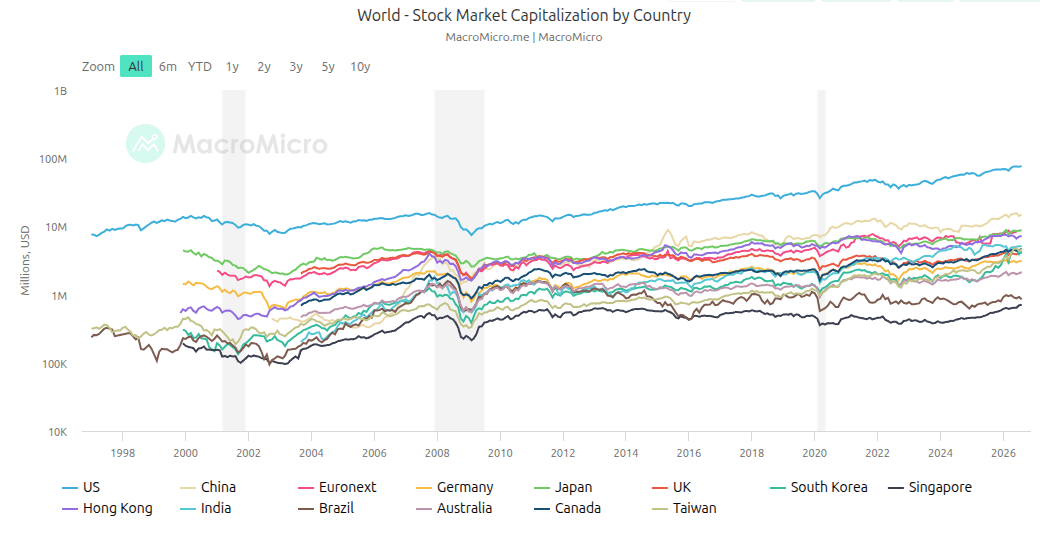
Note: right now America's CAPE ratio (a measure of how expensive stocks are relative to average earnings over the past 10 years) tends to run high — partly because the "tech frontier" narrative above is already priced in — so statistically, expected returns over the next decade tend to run more moderate, and this frontier advantage isn't permanent either (China keeps closing the gap in semiconductors and AI). The S&P 500 is also increasingly dominated by a handful of tech stocks, and as an Indonesian investor you still carry currency risk.
This isn't about lacking love for the home country — it's about being honest with the data. Indonesia's market capitalization is a tiny sliver of the global pie (well under one percent), liquidity in a lot of second- and third-tier stocks is thin, and the Sharia stock universe (JII) is far narrower than the S&P 500's.
Through a global lens (the EIDO ETF — holding Indonesian blue chips, traded in dollars on a US exchange): in dollar terms, its price movement over the past 10 years has been far flatter than the "IHSG always goes up" impression you get in rupiah — because a chunk of that rise is just the rupiah weakening, not real growth in company value.
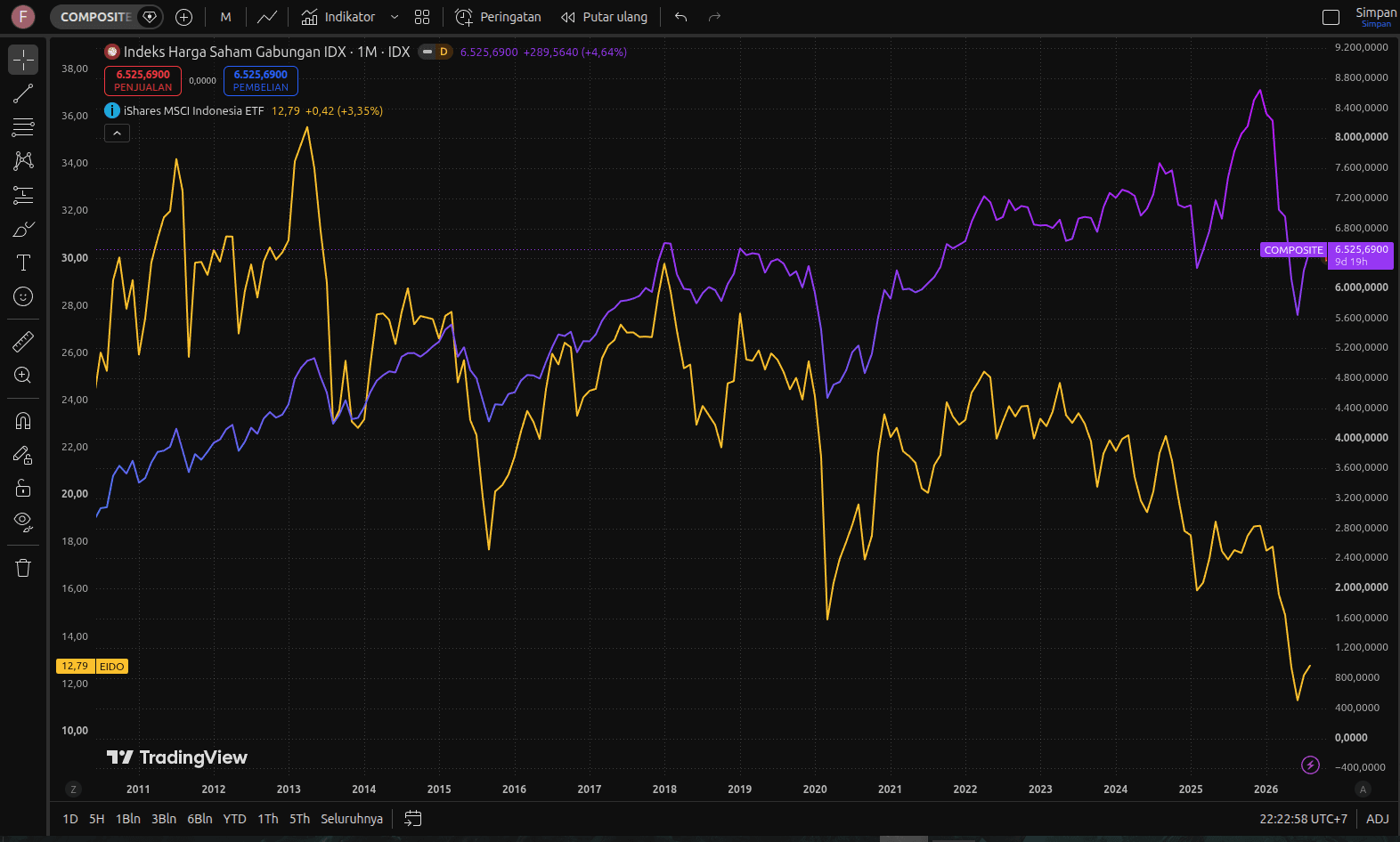
Note: domestic investing doesn't carry currency risk, gives easier access to local information, and a number of Indonesian blue chips have globally competitive dividend yields. A decade of data also isn't a guarantee the same pattern repeats — watch out for bias toward America and toward Indonesia alike.
To keep this balanced, here are a few of SPUS's honest weak points:
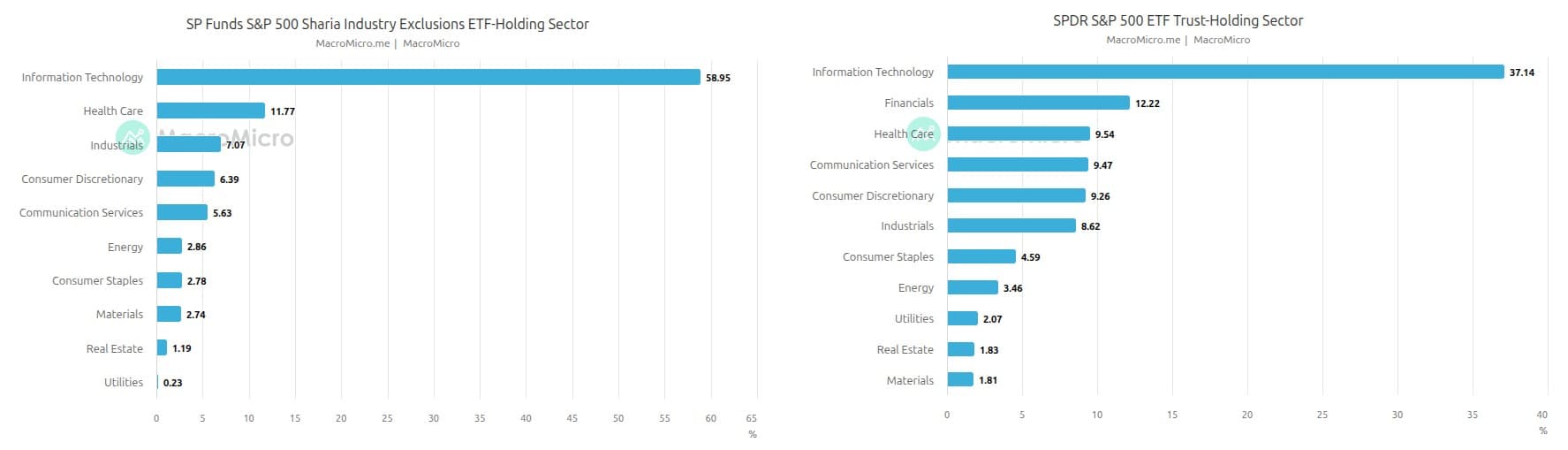
None of this is meant to scare you — it's meant to give you the full picture, not just the cool parts.
SPUS isn't a magic shortcut — you pay a bit more, still have to purify the leftover ash yourself, and still carry market and currency risk. But compared to the two extremes — closing your eyes and buying a conventional index as-is, or walking away entirely — buying the haystack while burning out the riba ends up being the most sensible option.
It all comes back to two simple principles: keep it simple — buy the entire haystack at once, no need to agonize over picking one winning stock, and always pick the winner — by buying the index, you automatically end up holding whichever winner shows up.
Even Warren Buffett — who beat the market for decades through stock picking — left the same instruction for his wife: put 90% of the funds into a low-cost S&P 500 index fund, the remaining 10% into short-term government bonds. Even the greatest investor of all time, for the person he cared about most, still chose to buy the entire haystack — not gamble on finding one needle alone.
Note: the figures in this article change over time — check the latest data before you act on them. This piece isn't financial advice or a Sharia fatwa — just a mapping of data to help you make your own decision.