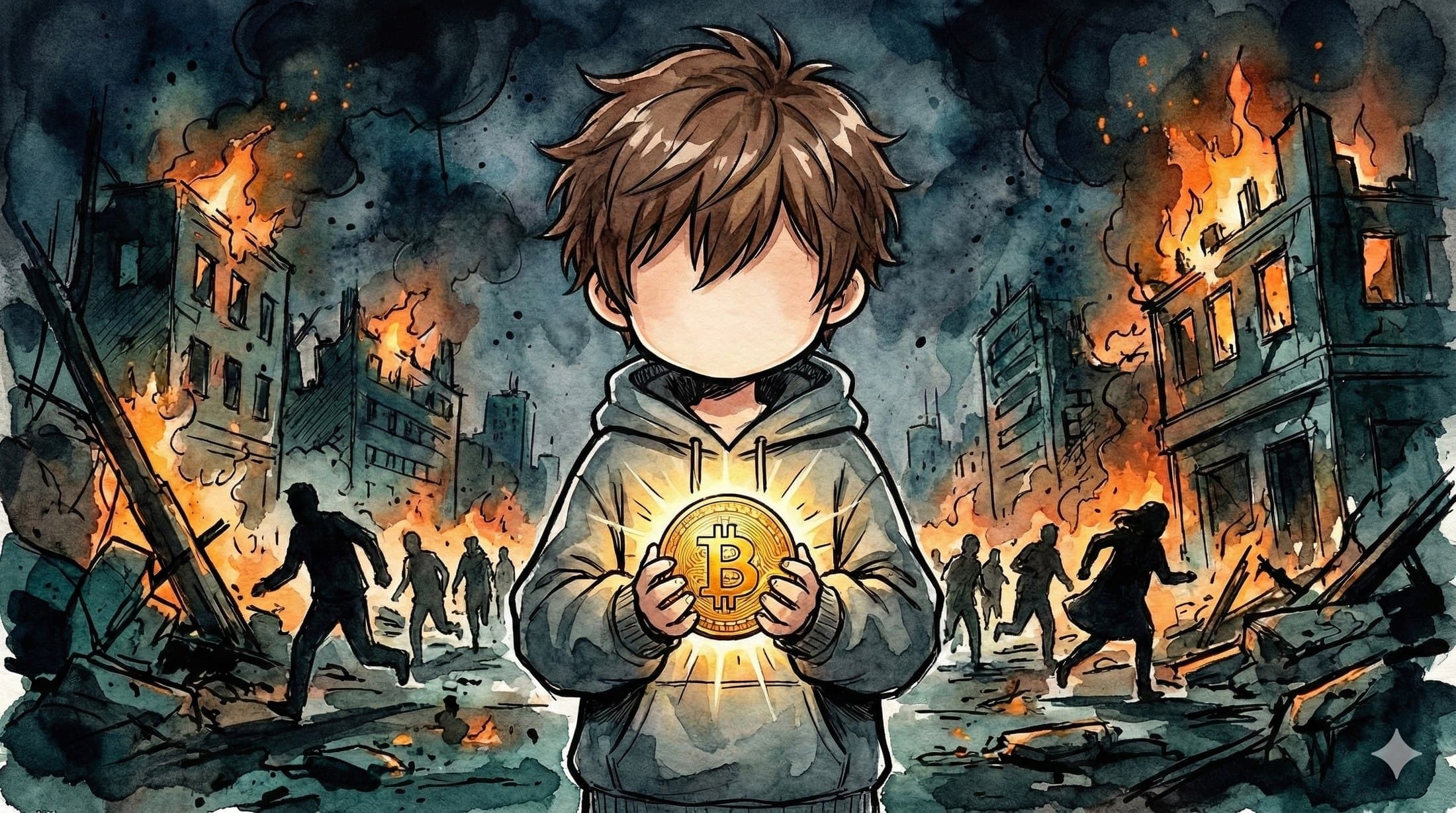
Why you were taught to trust your money without ever signing the contract — and how Satoshi Nakamoto built an alternative out of math instead of promises.
Ever feel like something's off? We work hard to earn money, while a handful of people can print new money whenever they feel like it.
From birth, we're told to trust that banks and governments will always protect the value of our money — even though none of us ever signed that contract. In 2008, when the global economy collapsed, Satoshi Nakamoto had had enough of this "forced trust."
What Satoshi wanted was "honest money" — money that didn't need human promises, only mathematical truth. That's where Bitcoin was born.
Picture this: you wake up, check your banking app, and your balance reads zero. You panic and call the bank, and all they say is, "Sorry, our records show your balance is zero."
What can you do at that point? You have no counter-proof. You're trapped inside a centralized system, where the truth belongs to a single party. If their system breaks, gets hacked, or they simply decide to cheat you, you're the one who loses.
Satoshi's solution was a stroke of genius called the blockchain. Think of it as a magic village ledger.
In this system, the financial record isn't locked away in one banker's drawer anymore. Every villager — from the shop owner to the farmer — gets an identical copy of the same ledger. The magic part: the moment a new transaction happens, every single copy updates itself, at the same instant.
Why call it "honest"? Say one dishonest villager tries to cheat by secretly editing his own balance to look bigger. The instant he tries to spend it, millions of other villagers open their own copies and shout back: "Hey, our records don't show that balance — you're lying!"
Technically, these ledgers are kept by tens of thousands of computers around the world called nodes. To rewrite even a single past transaction, an attacker can't just hack one server — they'd have to break into and alter millions of computers at the exact same time, which is close to impossible.
In Bitcoin, the truth no longer sits with one "boss" who can decide your fate — it sits with thousands of digital witnesses who can't be bribed. That's what we call decentralization.
You might be thinking, "Come on, any digital system can be hacked." Fair — Bitcoin is software, and all software carries risk. But Bitcoin has a unique way of defending itself, called Proof of Work.
Back in our village: to earn the right to write a page in the magic ledger, someone has to do genuinely hard physical labor — say, splitting 1,000 blocks of teak wood in a single minute. Whoever finishes first earns the right to submit their page.
But here's a fair question: if he's the fastest, can't he just write down whatever he wants — including fake transactions?
This is where it gets clever. Winning the wood-splitting race only earns you the right to present your page to the rest of the village. The moment you do, millions of villagers (nodes) instantly check it: Does the sender actually have enough balance? Is the signature real? Is he trying to spend money that doesn't exist?
If the winner is caught cheating, the page is rejected outright — thrown straight in the trash. He's already spent the electricity and effort, and walks away with nothing. Economically, cheating in Bitcoin is a losing bet.
In fact, the Bitcoin network's hashrate — think of it as the total "computing muscle" of millions of machines working together to secure the network — currently sits around 1,073 ZH/s (this number shifts daily, so treat it as a rough picture). To out-cheat that much collective honesty, you'd need electricity on the scale of roughly 10 nuclear reactors. It's like robbing one vault by having to burn down the entire city first just to get the key — which makes zero economic sense.
A lot of people are afraid Bitcoin is just a toy for global elites to control everyone else. It's actually the opposite. Because the code is open source, anyone can look under the hood.
Global elites can buy up huge amounts of Bitcoin, sure — but they can never become the "admin" who rewrites the rules. They can't force the system to mint more than 21 million coins. Here, even the most powerful person on earth has to submit to the code, not the other way around.
So what happens if Satoshi Nakamoto "wakes up" and sells every coin he holds? Think of Bitcoin as the invention of the wheel. Once the wheel exists, it belongs to the world, not to its inventor. If Satoshi resurfaced and sold his coins, the price might dip for a while as people panic — but the technology itself wouldn't break, not even slightly.
Note: back in 2017, the Bitcoin community fought hard over block sizes being too small to keep up with transaction demand (making it slow and expensive). Since no middle ground was found, part of the community eventually copied Bitcoin's old code and ran it as a separate network with bigger blocks — called Bitcoin Cash (BCH). That's what a hard fork is: not editing or hacking the original Bitcoin, but more like photocopying a recipe and having one "chef" split off into their own kitchen to cook a different version — the original kitchen (Bitcoin/BTC) keeps running exactly as before, untouched. The BCH camp wanted to stay cheap for everyday spending ("Cash"), while BTC itself chose to keep blocks small and lean more into being a long-term "store of value," like digital gold.
You've probably heard there are thousands of other "cryptos" (altcoins) that claim to be more advanced. Some genuinely offer things Bitcoin doesn't, like programmable smart contracts — so it's not fair to write off every altcoin as "a startup wearing a crypto costume"; some have real technical differentiation.
But plenty of them are pre-mined — meaning before the coin was ever sold to the public, the team had already minted and stockpiled a chunk for themselves. On top of that, many still have a CEO and a head office, which means they're not really decentralized the way Bitcoin is.
And then there's the crowd that's ultimately just a scam wearing a technology costume — claiming "revolutionary" features A, B, and C, when it's really just marketing and short-lived hype to pump the coin's price. The whitepaper looks impressive on paper, but when you actually check, the features never ship, or nobody ever uses them. That doesn't mean every altcoin is like this, but the pattern shows up often enough that a healthy dose of skepticism — and some homework before believing the marketing — is warranted.
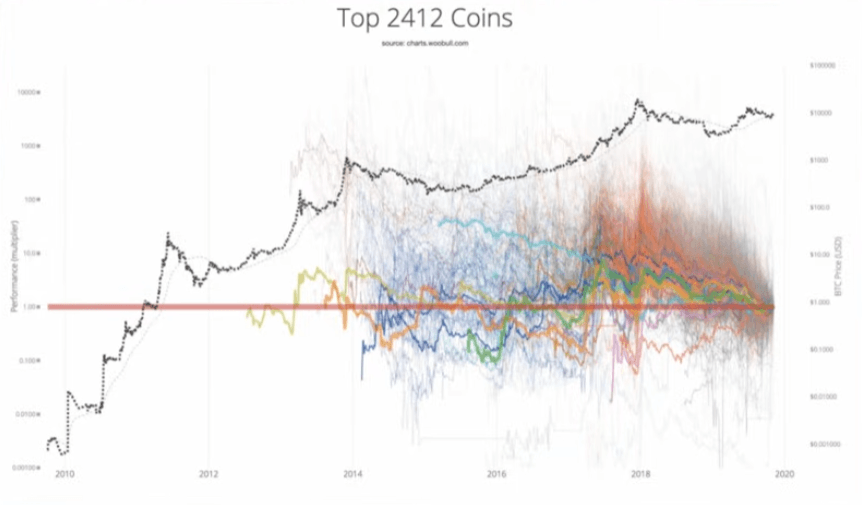
The historical data shows most altcoins crash hard from their peak once the market cycle ends — a pattern that's repeated across several cycles.
Note: past price data isn't a guarantee of what happens next, and it doesn't mean every altcoin is technically worthless.
This is the "checkmate" argument I hear most often, but let's think it through with simple logic. If the internet truly collapsed, would the bank you trust even still be breathing? ATMs stop dispensing cash, balances can't be checked, and the entire banking system grinds to a halt because it depends so heavily on a central connection.
Bitcoin tells a different story. Through Blockstream Satellite, Bitcoin's data is already being broadcast across the entire planet from orbit. And through projects like Jack Dorsey's BitChat, you can send Bitcoin using nothing but radio waves or Bluetooth — no internet provider required at all.
Note: these alternative paths are still fairly new and haven't actually been tested during a real, global-scale internet outage — so this is more "a design that makes it possible" than something proven battle-tested.
Gold is supposedly scarce, but here's the problem: nobody actually knows for certain how much gold really exists on Earth. Companies like AstroForge are working on technology to mine asteroids in space — though this is still extremely early-stage and far from proven economically viable any time soon, so treat it as a long-term risk, not a threat at the door.
There's another problem that rarely comes up: gold is heavy and takes up space. Owning a serious amount means you need a vault or dedicated storage, insurance to think about, and if you ever need to move it — fleeing a country, crossing a border — that's a logistical nightmare, hard to hide, and an easy target for robbery along the way. Compare that to Bitcoin: your digital wallet travels anywhere with zero physical footprint. Nobody knows you're carrying "wealth" unless you tell them.
Take the most extreme case: say you're kidnapped, your house is ransacked, everything you own is gone, and you end up dropped alone in the middle of a forest with nothing. If your entire net worth used to be gold or other physical assets, that's it — it's gone, buried with your house and your safe. But if it was Bitcoin, as long as you still remember your seed phrase — the 12 or 24 random words that back up all your private keys — you can type them into a fresh wallet on any phone or laptop, and your funds come back whole. No physical location needed, nothing to carry, just memory. But that's also a double-edged sword: anyone who learns or glimpses those 12 or 24 words gets full access, same as you — so being "easy to move" is also "easy to steal" the moment those words leak.
Note: gold does have a strength worth admitting honestly: it's held value for thousands of years, and it carries none of the "forget your private key and lose everything forever" risk that Bitcoin does.
You might be thinking, "Indonesian stocks only go up, the IHSG keeps climbing!" But let's look through the lens of a global investor, via BlackRock's EIDO ETF. An ETF is basically a "shopping basket" holding many stocks at once that you can buy like a single share.
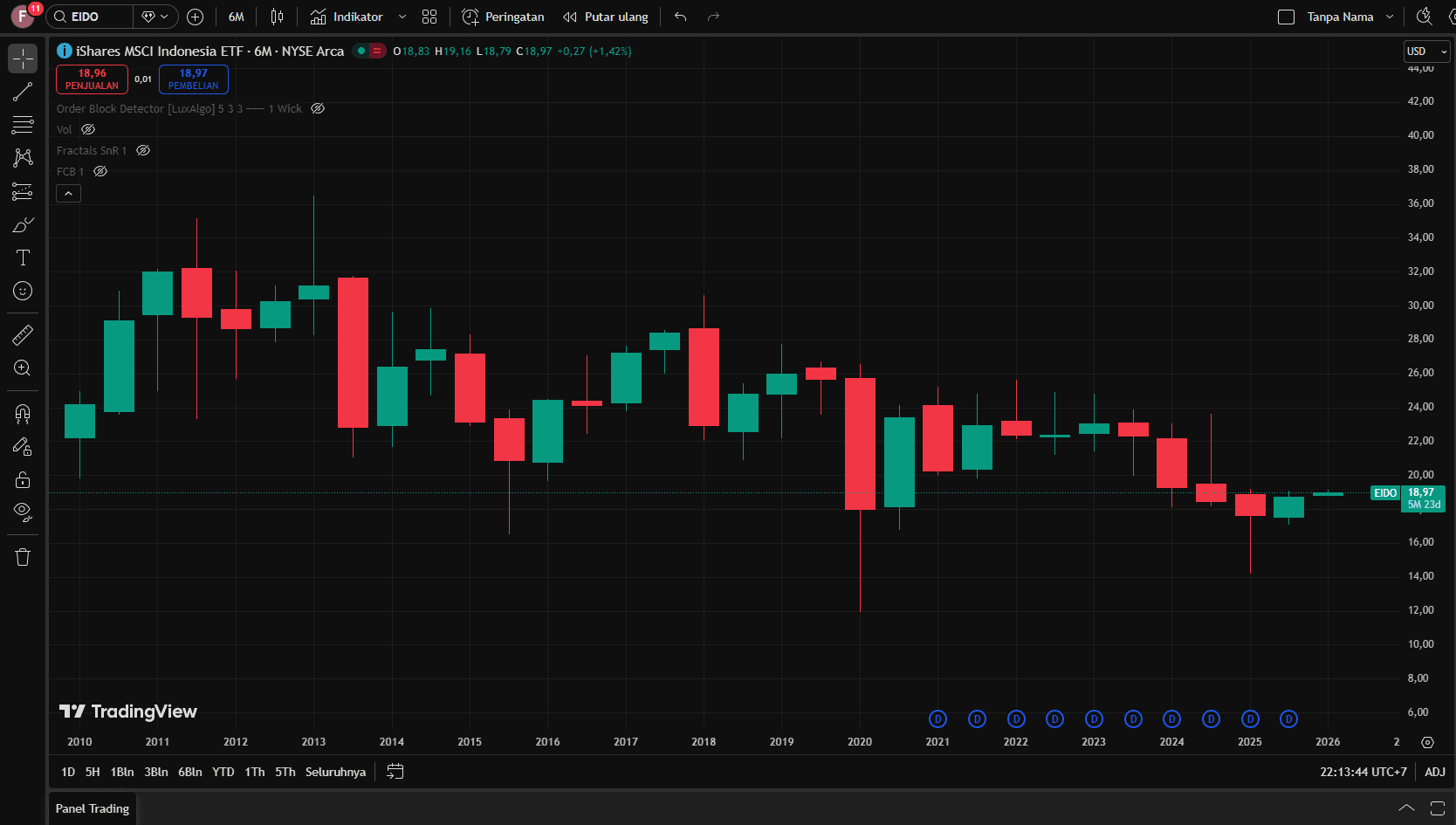
EIDO trades on a US exchange and holds a basket of the "giant" stocks that drive Indonesia's economy — not random picks, but blue chips (a term for large, established, trusted companies — the "senior players"), names like BBCA, BBRI, BMRI, BBNI, TLKM, ASII, and ICBP.
Open the EIDO chart priced in dollars, though, and it's a shock: over the past 10 years, the line has essentially gone nowhere. We feel like we're winning because the Rupiah number keeps climbing, but that's only because our Rupiah keeps getting weaker against the dollar — what's called currency risk (a loss that comes not from the investment itself, but from the currency it's denominated in losing value).
Note: owning stock means owning a claim on a genuinely productive company that can pay dividends — something Bitcoin doesn't offer. And historically, Bitcoin's price swings far more wildly than the IHSG, so its short-term risk runs higher too.
To keep this balanced, here are a few of Bitcoin's honest weak points:
None of this is meant to scare you — it's meant to give you the full picture, not just the cool parts.
Satoshi Nakamoto himself once said this to someone who doubted Bitcoin: "If you don't believe me or don't get it, I don't have time to try to convince you, sorry."